Patricia Temples Photography

MAKE IT AN ADVENTURE! All rights reserved.

Archive for the category “ART”

Woven Photography

I learned about a new way to present photographs at an art exhibition at the Virginia Mennonite Retirement Community in Harrisonburg, Va a few years ago. It is woven photography. The artist that was in that show had 3D woven photographs, in which he wove small wire into the piece so that he could make a vessel that could be shaped and could stand alone. He had a very interesting piece in that show. I contacted him and he most generously gave me all kinds of information about how it is done. I learned along the way that there is no harm in sharing that information, because each photographer who uses this technique would use their own images, their own weaving patterns, and their own ideas of how to modify one image in two ways to weave them together. I have learned a lot of things since I first started doing this. Some images work better than others, there are several weaving patterns someone could use, and weaving as a left-hander makes my weavings unique to me. Here are some examples of the work I’ve done, and I hope you can see a progression in my choices of photos along the way.

Let me explain what I actually do. I print two of the same image, with or without modifications in one of the images. I also print on the back of each image a cutting template, one with 1/4″ wide horizontal cutting lines and one with 1/4″ vertical lines, then I cut the images apart. On the horizontal cut, I leave a bit uncut at the top of the image to hold the pieces together. The vertical pieces are cut one at a time, and woven into the horizontally cut image.
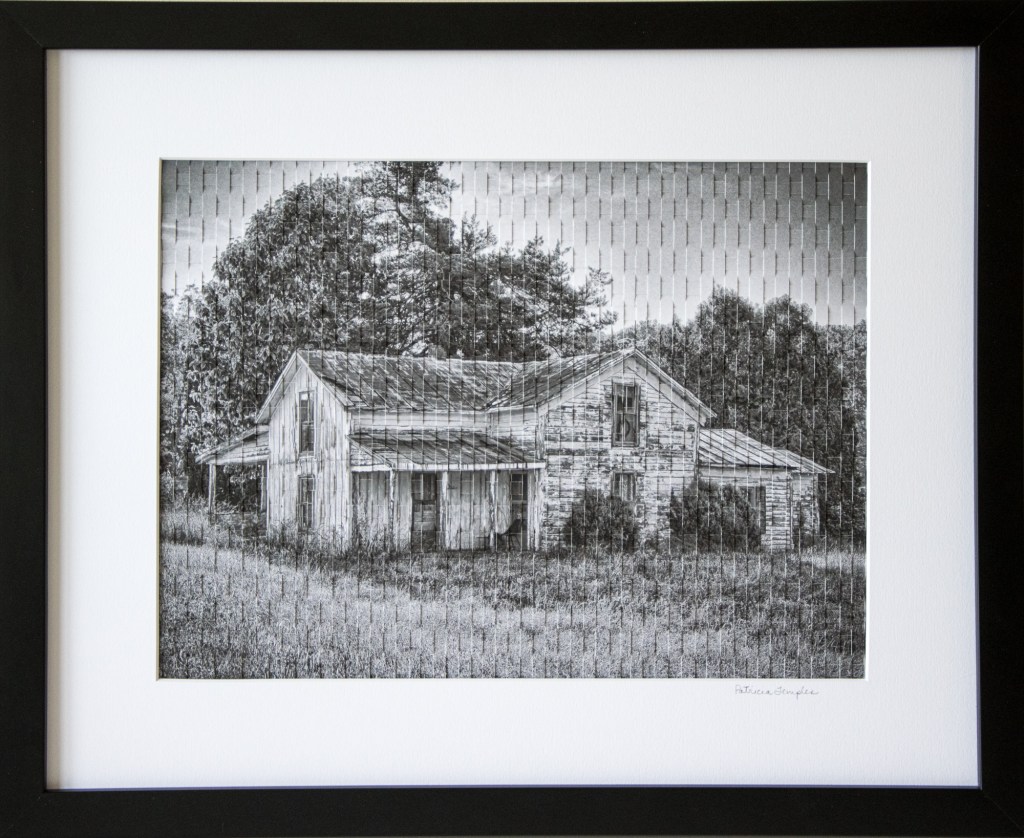
This was the first image I created when I started in 2018. I wove together two black and white images with a simple tabby pattern. I put it in an art show in Bath County that year and it sold, so I only have this photo now. You can see the simple in and out pattern of the weaving, alternating the starting point on each row.

A year later I made this piece, using a twill weave. In that pattern you start with one under, then two over, two under, continuing throughout the row. The next row begins with two under, two over, two under, and so forth. I used one black and white image and one color image on this corrugated metal barn photo. You can see the twill pattern quite easily because of the color differences. Because I am left-handed, the “stripes” run in a left-to-right diagonal pattern.
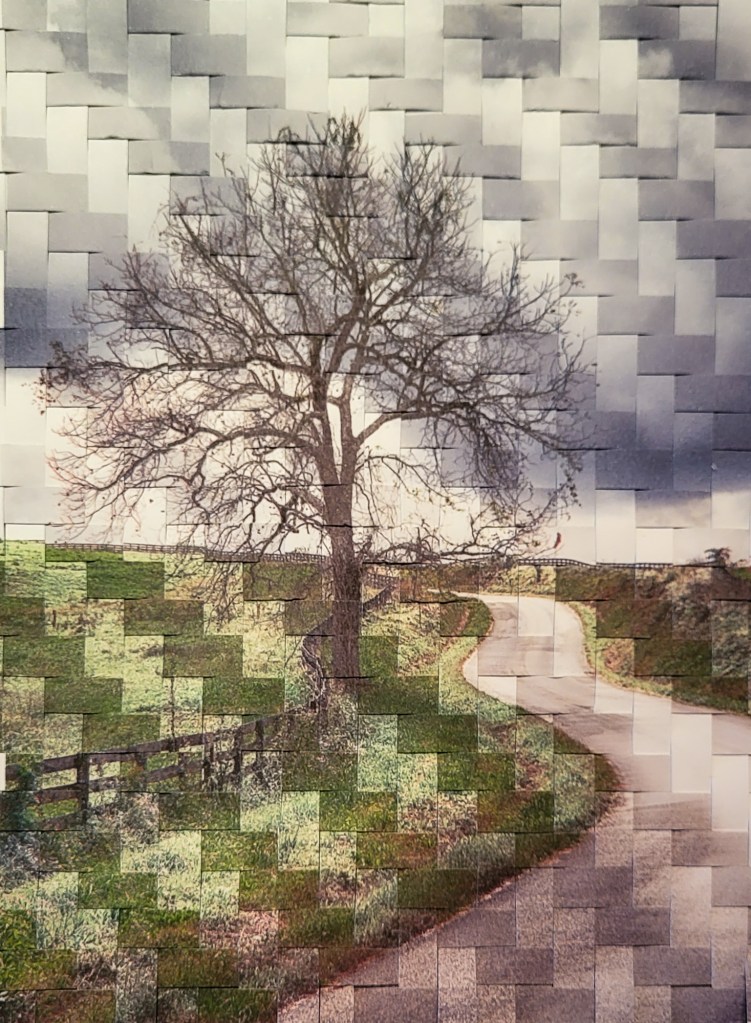
This was made using two 5×7 photos, one darker than the other, but both in color. Again, you can see the diagonal movement because of the twill weave. These stripes look larger because the image is smaller. I called this one Quilted Landscape because I think the stripes in the green area look like a quilt lying on the ground. This one sold about a month after I finished it.

I chose to do this image again, this time without as much difference in the saturation of color. I called the new one Storm Coming In, and it will be in the Bath County Arts Association Show this summer. I do not have a good photograph of this one because of reflections on the glass.

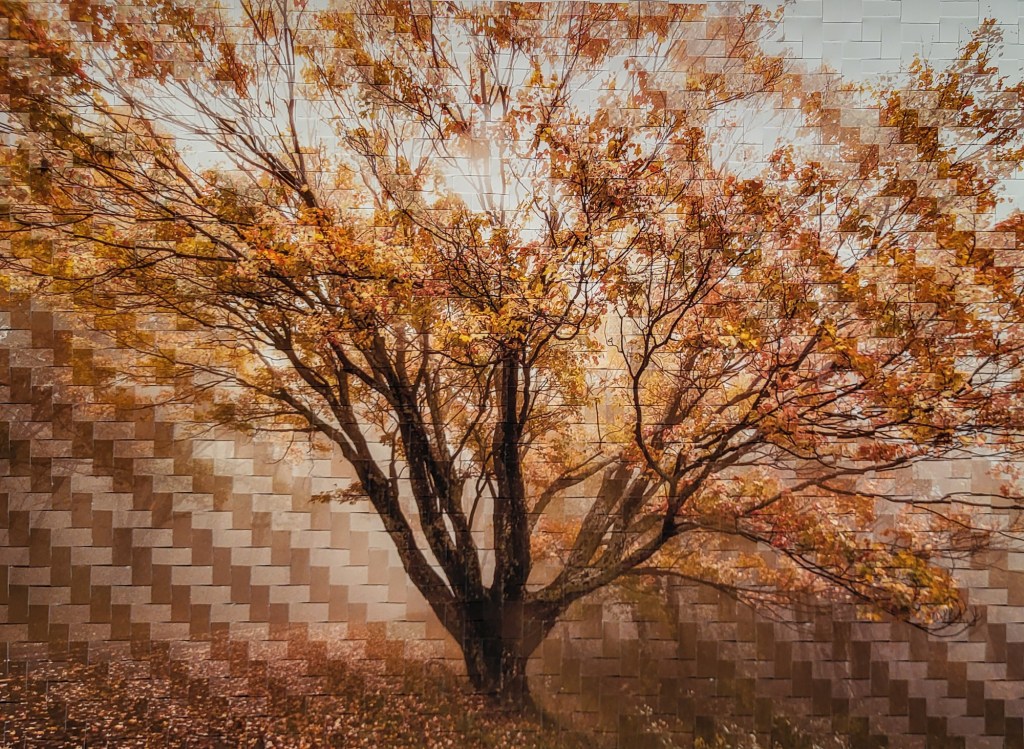
My next attempt was with a photograph of a bright orange maple tree in Shenandoah National Park. I wasn’t sure I was going to like it. Before I completed it I showed it to a couple of friends and they both wanted to purchase it, so I will be making a second one of this image soon. It is not framed yet, and the photograph was taken with my phone as it lay on a counter. Sorry. I’ll try to put a better photo up after I get it completed. My goal will be to make changes somehow so the second one is not exactly like the first. We’ll see what I come up with. Enjoy!!
Small Towns

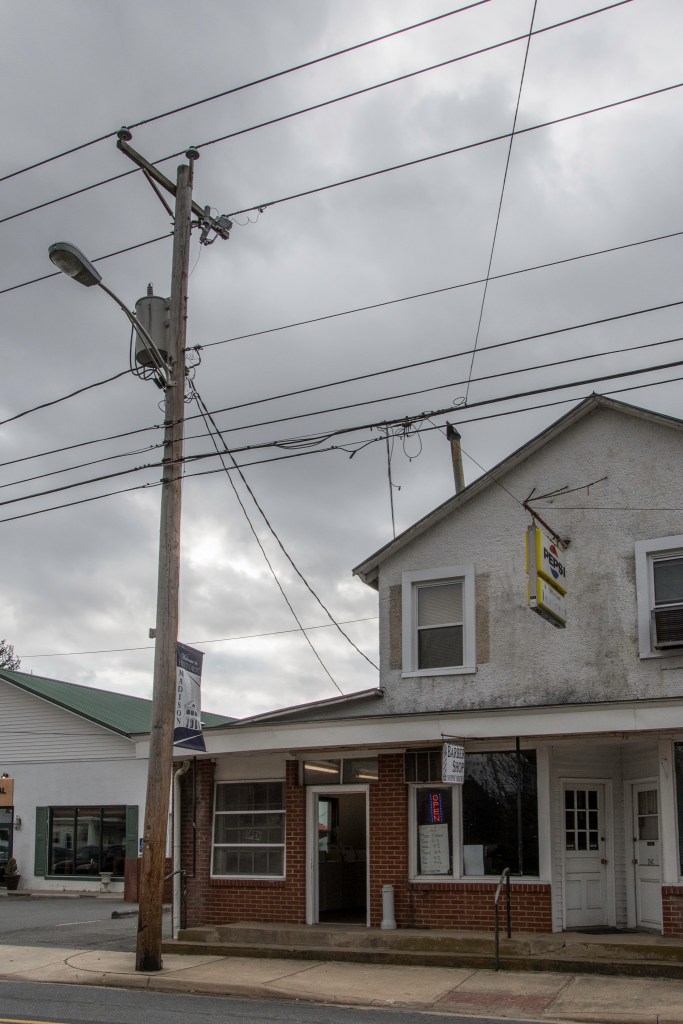
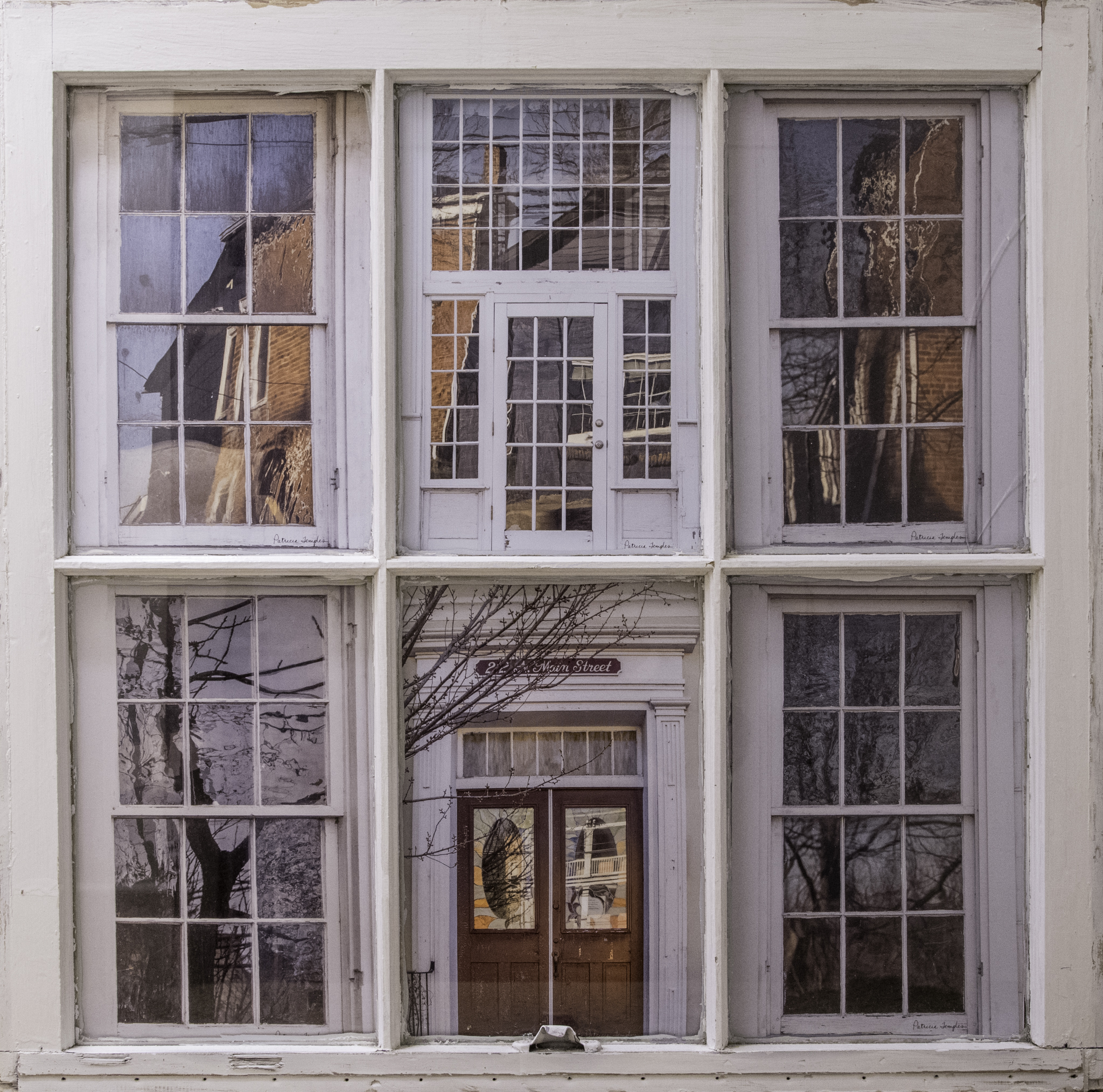
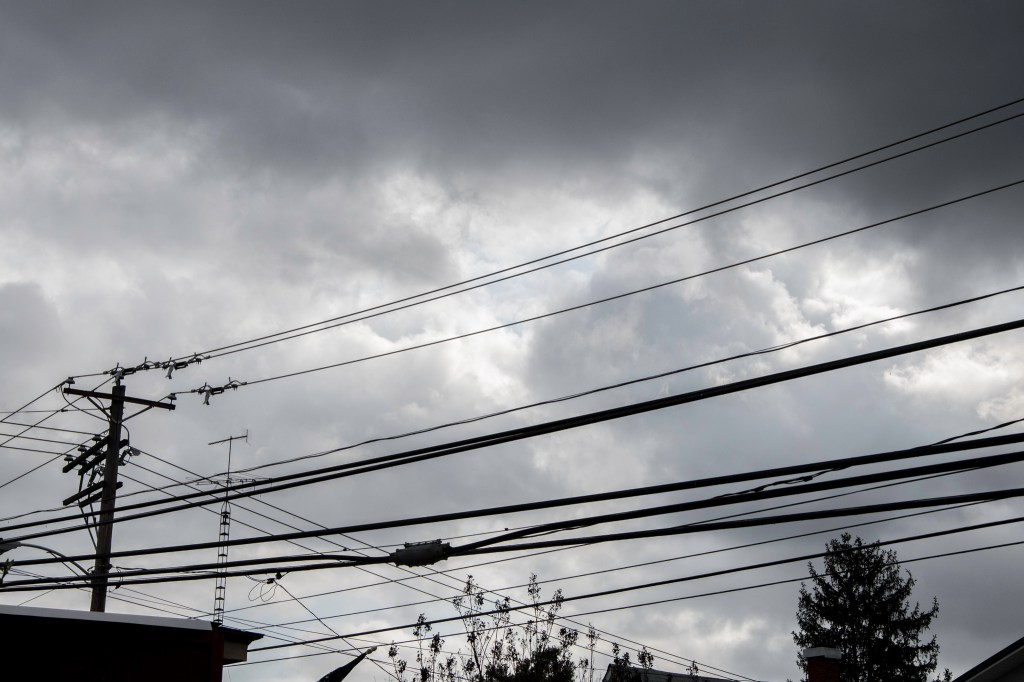
I had a photography project in mind as I prepared for an upcoming show with my artists’ group.  How about photographing a small town near my home and putting the images in an old window instead of in frames?  I headed out early one morning to start gathering the images.  There are a lot of quaint older buildings in this town, many of which are empty, and I had no trouble finding some I wanted to document.  A beautiful old hotel with balconies and interesting stairs caught my eye.  But, then, the scourge of photographers appeared in my viewfinder…..power lines.

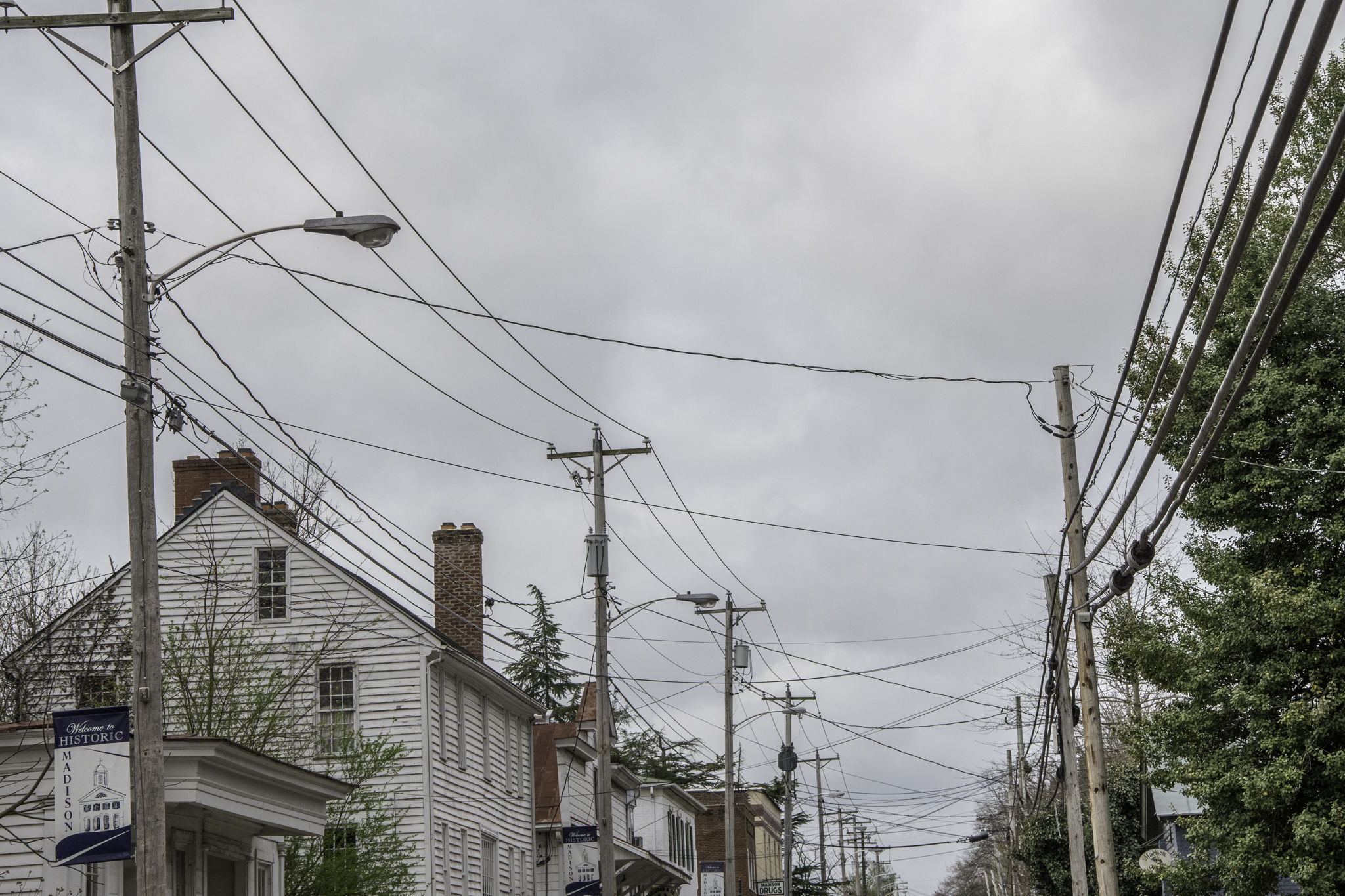
Small towns have a lot of power lines.  Big power lines, little power lines that are crisscrossing the street and each other.  Now I have a problem.  I cannot photograph these beautiful buildings without having a power line in each shot.  Here’s what I was seeing.

Poles and LInes 3Poles and LInes 2Poles and LInes 1

But, as luck would have it, as I walked and shot, going down the street on one side and returning on the other, I started seeing reflections in the windows along Main Street.  Beautiful reflections, distortions of reflections, and distortions in the old glass. You can even see distorted face shapes in these windows.

Reflelctions 1Reflelctions 2Reflelctions 3

So, I kept shooting, excited about what I was seeing and how I could use them in my art piece.  This is the result of many hours of shooting, planning, re-sizing, moving images around, printing more images to try out, on and on.  I like it.

Reflections on Main

Woodberry Forest School, Upcoming Art Show

On September 5th, the artists of Firnew Farm Artists Circle will open their show “New Beginnings” in the Walker Fine Arts Building on the campus of Woodberry Forest School. A reception will be held from 5-7 pm and promises the attendees wonderful art to explore and local food to taste.

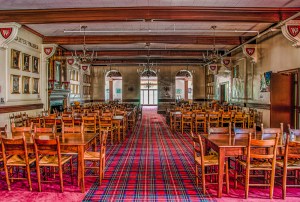
Reynolds Family Dining Hall

I have three photographs in this show that were taken on the campus of Woodberry Forest School this summer.  Most of you know by now that I look for and love to find coincidences and connections between my current life and something in my past.  Well, I found it at WFS.  I took this photograph of the dining hall, a beautiful, quaint room with warm colors, Clore furniture handmade in Madison County, and plenty of history.  As I was trying to determine a name for this photograph, I had to ask for information about it from a faculty member. I learned that the dining hall is called “Reynolds Family Dining Room.” I had previously learned that Bowman Gray, Jr. had attended WFS.  He was a former president of Reynolds Tobacco, but that didn’t tell me about this dining room. Of course I did an online search and found a more direct connection between the Reynolds family and WFS.  But, before I tell you that connection, let me tell you about my own, somewhat weak, connection to the Reynolds family.

I grew up in Patrick County, Virginia.  A little community in my county is Critz, and it is the location of the Reynolds Homestead.  Hardin Reynolds was the patriarch of this family who lived in Critz, and two of his sons were responsible for founding Reynolds Tobacco Co. and a third founded Reynolds Metals and Reynolds Aluminum.  My nephew is currently teaching at Hardin Reynolds Elementary School in Patrick County.

The member of the Reynolds Family who attended Woodberry Forest was J. Sergeant Reynolds, son of the founder of Reynolds Metals.  “Sarge” went on to become Lieutenant Governor of Virginia in the late 1960s.  Sadly, he developed a brain tumor and died at age 34 in June 1971 (coincidentally, the month I graduated from college).  He is buried at the Reynolds Homestead.  Virginia lost a rising star when he died.

There’s the connection.  My photograph of the Reynolds Family Dining Room took me back to my roots in Patrick County.  I suppose as a lifelong Virginian, I should not be surprised when I find links to other Virginians, but it continues to delight me, no matter how tenuous the link might be.

It’s Getting a Bit Crazy

I have written in previous posts about my art collaborations with two friends, one a watercolorist, the other a colored pencil artist.  That isn’t a totally accurate description of my friends’ talents:  they both use a variety of media in their work.  I am the photographer, and that’s about all I do.  Oh, well. We have completed a seventh collaborative art piece, and this one was the most challenging yet.  As we progressed on the work, we all had doubts about whether it would be a successful piece of art when we finished.  That doubt lingered until it all came together. Yesterday we matted and framed it and showed it to our artists’ group.  It was a hit!  It will be in a show at Woodberry Forest School in Orange VA, September 5 through November 3.  If you live nearby or within an easy drive, try to come to our reception on September 5th, 5-7 pm.  There will be a lot of great art, great food, wine and wonderful artists to make the evening enjoyable.

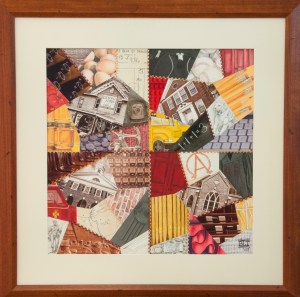
So….what is our collaboration?  We made a crazy quilt.  Not out of fabric, but out of paper.  Let me tell you first about crazy quilts.

The history is a bit confusing.  One source says they became popular in the late 1880s in the US, but another says that they originated during Colonial Times.  I will give you my take on what I’ve read.  I believe that the Colonists, who came from Europe with limited supplies, started using patchwork as a way to repair old and torn garments so that they could continue to be worn.  They probably didn’t start out as beautiful, but more functional in nature.  As fabric became readily available, the artistry and design components followed for quilting in general.  In the late 1880s the CRAZY quilt emerged among the wealthier classes as a way for them to show off expensive fabrics and their extensive embroidery skills.  Oddly shaped pieces of silks, velvets and satins were sewn together and embellished with a large variety of embroidery styles.  As the popularity of quilting increased, quilters began to establish themes to commemorate an important event, or they used fabrics that were of sentimental significance in their lives. Crazy quilts were not created for warmth or function, but for decorative use.  I have three of these quilts in my possession, all pieced and embroidered by my great-grandmother, with satin on the opposite side that my grandmother quilted.  These quilts were presented to all female members of my family.  Oddly enough, crazy quilts were rarely “quilted” per se.  The embroidery was embellishment enough.

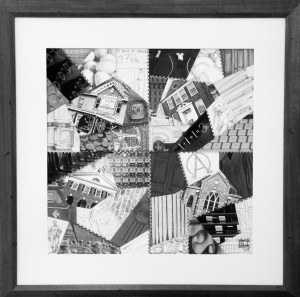
But, I digress.  I was talking about an art collaboration, wasn’t I?  Yes, we made a crazy quilt.   None of us were sure we could pull it off.  I will show you first what our finished piece looks like in black and white.  Notice the placement of the light and dark pieces.  I see movement and texture. Do you?


Black and White Study


This is our finished art quilt.  The colors we chose are warm golds and reds, some grey and black, and sepia tones.  See if you can determine which square addresses each segment of a community.  Then see if you can name all of the things within the square that support it. This collaboration is large.  The finished size is 24″ x 24″ framed.  You need to see it up close and personal!


The Finished Product

The Finished Product


A quote from the book Crazy Patchwork, 1884, says this:  “No species of fancy-work yet invented has ever given more scope for the exercise of artistic ability and real originality:  hence, the secret of its popularity.”

I would say that the Crazy Quilt has once again provided an avenue for creativity, artistic ability and originality.  Leslie Barham, Frances Lacy and I hope you feel the same way.


Voices of the Land

I’ve been away from my blog for several months as I completed a project for the Blue Ridge Foothills Conservancy.  Called “Voices of the Land,” it is a mini-documentary of the last working dairy farm in Greene County, Virginia.  Photographs of the farm, both from a distance and from within, provide viewers with an opportunity to see how a dairy operates and to experience the beauty of the land that supports the dairy operation.  Originally the project was designed to be twelve aesthetic photographs, but with the title “Voices of the Land” I felt that there needed to be accompanying audio recordings by the brothers who own the farm. Interviews with the brothers revealed their love of the farm and the animals, and their great memories as children of growing up in an environment where hard work was the norm.  Milking cows cannot be done “when you feel like it.”  It is done twice a day on a regular schedule.  As children, the brothers went to work at dawn, then went to school (where sometimes they fell asleep at their desks), and in the afternoon, they returned to the farm to work past sunset.  If there was time and energy left, schoolwork was completed.  Commitment is the operative word of a dairy farmer.

As the project took shape, a slideshow emerged.  Using the (now) thirteen original photographs as the foundation, the voices of the farmers were added, then supplemental photographs completed the story.  The final product was a 25-minute slideshow with a history of the farm and descriptions of how the farm operates, as told by the brothers who have lived on the farm for over sixty years.  An additional feature of the project are QR codes that accompany each of the thirteen printed and displayed photographs, which allows access to a short clip by using a QR reader on a smart phone.  Below is the first image in the slideshow, and the QR code which accompanies it.  In this clip you will hear the history of Fairview Farm as told by one of the brothers.  Prints of ten of the images and copies of the DVD are available for purchase via the Blue Ridge Foothills Conservancy website:  www.blueridgefoothillsconservancy.org.

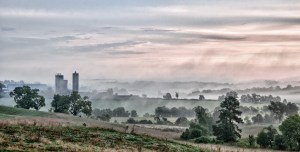
Fog over Fairview Farm qrcode.photo10

More Collaboration

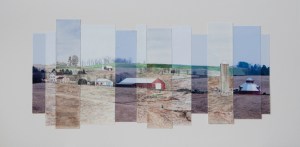
Earlier I wrote about my opportunity to collaborate on some art pieces with two friends, one who is a colored pencil artist and the other a watercolorist.  We have just completed two more pieces, which I believe are even more spectacular than our first three.  For these, we cut photos apart.  Each of us took some of the pieces to work on, but they had to fit back together just so to complete the larger composition.  I am a photographer, and it was a challenge to determine how to create new pieces from the sections I had to modify.  Take a look.  See if you can determine which pieces belong to which artistic medium.  Good luck!

Strip Farming

Thirty-six different signs of life adorn this creation.

Thirty-six different signs of life adorn this creation.

Post Navigation

Our Cape Escape

renovation realities

The Mansurovs

Digital Photography Tips, Recipes, Technology and Photographs from The Mansurovs

Perception

Photography. Life.

cookiecrumbstoliveby

Life through the eyes of "cookie"

The Legion of Door Whores

...for those who appreciate doors...

Ray Ferrer - Emotion on Canvas

** OFFICIAL Site of Artist Ray Ferrer **

Belle Grove Plantation Bed and Breakfast

Birthplace of James Madison and Southern Plantation

Leaf And Twig

Where observation and imagination meet nature in poetry.

Firnew Farm Artist's Circle

We meet weekly, and host: Review & Critique of New Works. Our Annual Spring Show is in May and our Annual Fall Show is September - October. Contact: Trish Crowe 540 948 3079

John Berry Photography

Portrait, Sports, Landscape Photographer in Central Virginia

CJ's Workshops

FILM INSPIRES!